EMT Practice Test

1. Question Content...


Question List

Question1: For a given Virtual Server, the BIG-IP must perform SSL Offload and negotiate secure communication overTLSvl.2only.
What should the BIG-IP Administrator do to meet this requirement?

Question2: Which two statements are true concerning the default communication between a redundant pair of BIGElIP systems. (Choose two.)

Question3: Assuming other failover settings are at their default state, what would occur if the failover cable were to be disconnected for five seconds and then reconnected?

Question4: A user needs to determine known security vulnerabilities on an existing BIG-IP appliance and how to remediate these vulnerabilities.
Which action should the BIG-IP Administrator recommend?

Question5: A BIG-IP Administrator sees the following error message in /var/log/ltm diskmonitor: *******; Disk partition shared has less than 30$ free Which section of the Configuration Utility should the BIG-IP Administrator access to investigate this error message?

Question6: Interface 1.2 on a BIG-IP VE has a status of UNINITIALIZED. What is the reason for this status?

Question7: A BIG-IP Administrator is conducting maintenance on one BIG-IP appliance in an HA Pair. Why should the BIG-IP Administrator put the appliance into FORCED_OFFLINE state?

Question8: A site has six members in a pool. All of the servers have been designed, built, and configured with the same applications. It is known that each client's interactions vary significantly and can affect the performance of the servers.
If traffic should be sent to all members on a regular basis, which loadbalancing mode is most effective if the goal is to maintain a relatively even load across all servers?

Question9: A BIG-IP Administrator needs to collect HTTP status code and HTTP method for traffic flowing through a virtual server.
Which default profile provides this information?

Question10: A BIG-IP Administrator receives an RMA replacement for a failed F5 device. The BIG-IP Administrator tries to restore a UCS taken from the previous device, but the restore fails. The following error appears inthe/var/log/itm.
mcpd [****J: ******>;0; License is not operational (expired or digital signature does not match contents.) What should the BIG-IP Administrator do to avoid this error?

Question11: Which process or system can be monitored by the BIGElIP system and used as a failElover trigger in a redundant pair configuration.

Question12: Refer to the exhibit.

How many nodes are represented on the network map shown?
Question13: A BIG-IP Administrator reviews the log files to determine the cause of a recent problem and finds the following entry.
Mar 27.07.58.48 local/BIG-IP notice mcpd {5140} 010707275 Pool member 172.16.20.1.10029 monitor status down.
What is the cause of this log message?

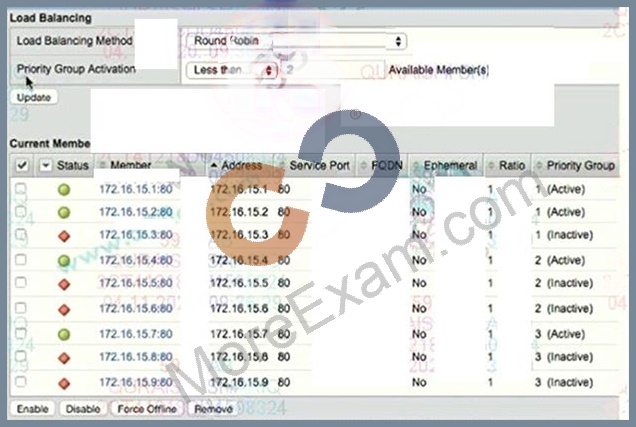
Question14: Refer to the exhibit.

Which two pool members should be chosen for a new connection? (Choose two.)

Question15: Which three statements describe a characteristic of profiles. (Choose three.)

Question16: What is required for a virtual server to support clients whose traffic arrives on the internal VLAN and pool members whose traffic arrives on the external VLAN.

Question17: How is MAC masquerading configured?
Question18: A BIGJP Administrator needs to load a UCS file but must exclude the license file. How should the administrator perform this task?

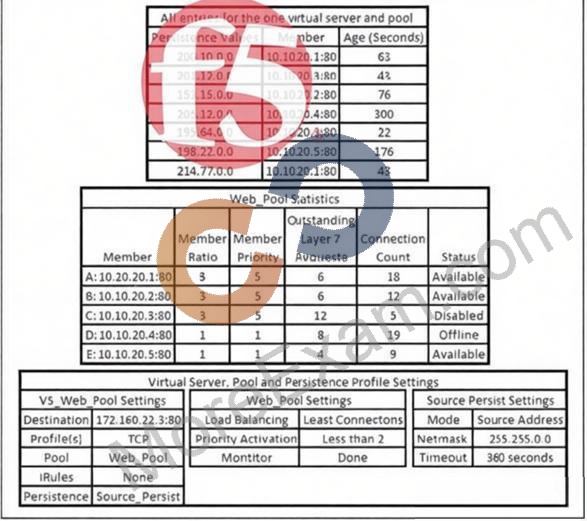
Question19: A virtual server is defined using a sourceEladdress based persistence profile. The
last five connections were A, B, C, A, C . Given the conditions shown in the graphic,
if a client with IP address 205.12.45.52 opens a connection to the virtual server,
which member will be used for the connection.

Question20: A Virtual Server uses an iRule to send traffic to pool members depending on the URI. The BIG-IP Administrator needs to modify the pool member in the iRule.
Which event declaration does the BIG-IP Administrator need to change to accomplish this?

Question21: Which VLANs must be enabled for a SNAT to perform as desired (translating only desired packets)?

Question22: Which Virtual Server type prevents the use of a default pool?
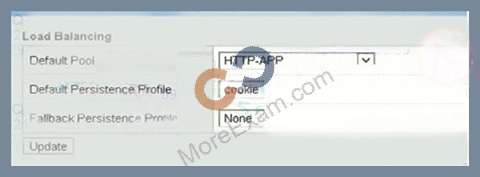
Question23: Refer to the exhibit.

Due to a change in application requirements, a BIG-IP Administrator needs to modify the configuration of a Virtual Server to include a Fallback Persistence Profile.
Which persistence profile type should the BIG-IP Administrator use for this purpose?

Question24: Which statement is true concerning a functional iRule?

Question25: What is the purpose of MAC masquerading.
Question26: A BIG-IP Administrator needs to apply a license to the BIG-IP system to increase the user count from the base license.
Which steps should the BIG-IP Administrator?

Question27: A custom HTTP monitor is failing to a pool member 10.10.3.75:8080 that serves up www.example.com.
A ping works to the pool member address.
The SEND string that the monitor is using is: GET/HTTP/l.l/r/n/Host.www.example.com/r/n/Connection Close/r/n/r/n Which CLI tool syntax will show that the web server returns the correct HTTP response?

Question28: A BIG-IP Administrator is checking the BIG-IP device for known vulnerabilities. What should the 8IG-IP Administrator upload to BIG-IP iHealth for further analysis?

Question29: A virtual server at 10.10.1.100:80 has the rule listed below applied. when HTTP_REQUEST { if {[HTTP::uri] ends_with "htm" } { pool pool1 } else if {[HTTP::uri] ends_with "xt" } { pool pool2 } If a user connects to http://10.10.1.100/foo.txt which pool will receive the request?

Question30: Refer to the exhibit.

An LTM device has a virtual server mapped to www.f5.com. Users report that when they connect to
/resources/201.1.2h.l_l.com they are unable to receive content.
What is the likely cause of the issue?

Question31: Refer to the exhibit.

A BIG-IP Administrator configures a Virtual Server to handle HTTPS traffic. Users report that the application is NOT working.
Which actional configuration is regard to resolve this issue?

Question32: A virtual server is listening at 10.10.1.100:80 and has the following iRule associated with it:
when HTTP_REQUEST { if { [HTTP::header UserAgent] contains "MSIE" }
{ pool MSIE_pool }
else { pool Mozilla_pool }
If a user connects to http://10.10.1.100/foo.html and their browser does not specify a UserAgent, which pool will receive the request?

Question33: Which parameters are set to the same value when a pair of BIG-IP devices are synchronized?

Question34: A standard virtual server has been associated with a pool with multiple members.
Assuming all other settings are left at their defaults, which statement is always true
concerning traffic processed by the virtual server.

Question35: A BIG-IP Administrator needs to have a BIG-IP linked to two upstream switches for resilience of the external network. The network engineer who is going to configure the switch instructs the BIG-IP Administrator to configure interface binding with LACP. Which configuration should the administrator use?

Question36: Refer to the exhibit.

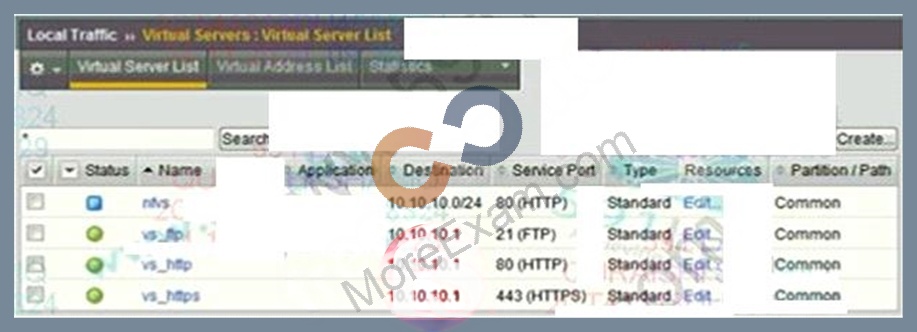
A user attempts to connect to 10.10.10.1.80 using FTP over SSL with an FTPS client. Which virtual server will match and attempt to process the request?

Question37: How is persistence configured.

Question38: Which event is always triggered when a client initially connects to a virtual server configured with an HTTP profile.

Question39: A standard virtual server is defined with a pool and a SNAT using automap. All other settings for the virtual server are at defaults. When client traffic is processed by the BIGElIP, what will occur to the IP addresses.

Question40: Administrative user accounts have been defined on the remote LDAP server and are unable to log in to the BIG-IP device.
Which log file should the BIG-IP Administrator check to find the related messages?

Question41: Which two statements are true about NATs? (Choose two.)

Question42: A 8IG-IP device is replaced with an RMA device. The BIG-IP Administrator renews the license and tries to restore the configuration from a previously generated UCS archive on the RMA device. The device configuration is NOT fully loading. What is causing the configuration load to fail?

Question43: A BIG-IP Administrator is working with a BIG-IP device and discovers that one of the Interfaces on a Trunk is DOWN.
What is the reason for this Interface status?

Question44: Which two statements are true about SNATs? (Choose two.)

Question45: How is persistence configured?
Question46: A BIG-IP Administrator finds the following log entry after a report of user issues connecting to a virtual server:
01010201: 2: Inet port exhaustion on 10.70.110.112 to 192.28.123.250:80 (proto 6) How should the BIG-IP Administrator modify the SNAT pool that is associated with the virtual server?

Question47: A virtual server is listening at 10.10.1.100:any and has the following iRule associated with it:
when CLIENT_ACCEPTED { if {[TCP::local_port] equals 21 } { pool
ftppool } elseif {[TCP::local_port] equals 23 } { pool telnetpool }
If a user connects to 10.10.1.100 and port 22, which pool will receive the request?

Question48: A BIG-IP Administrator makes a configuration change to the BIG-IP device. Which file logs the message regarding the configuration change?

Question49: A BIG-IP Administrator plans to resolve a non-critical issue with a BIG-IP device in 2 weeks. What Severity level should be assigned to this type of F5 support ticket?

Question50: A BIG-IP Administrator applied the latest hotfix to an inactive boot location by mistake, and needs to downgrade back to the previous hotfix.
What should the BIG-IP Administrator do to change the boot location to the previous hotfix?

Question51: A node is a member of various pools and hosts different web applications. If a web application is unavailable, the BIG-IP appliance needs to mark the pool member down for that application pool. What should a BIG-IP Administrator deploy at the pool level to accomplish this?

Question52: Which statement accurately describes the difference between two loadbalancing modes specified as "member" and "node"?

Question53: As a part of the Setup Utility, the administrator sets the host name for the BIG IP. What would be the result if the two systems in a redundant pair were set to the same host name?

Question54: A BIG-IP Administrator needs to restore an encrypted UCS archive from the command line using the TMSH utility.
Which TMSH command should the BIG-IP Administrator use to accomplish this?

Question55: Which action will take place when a failover trigger is detected by the active system?
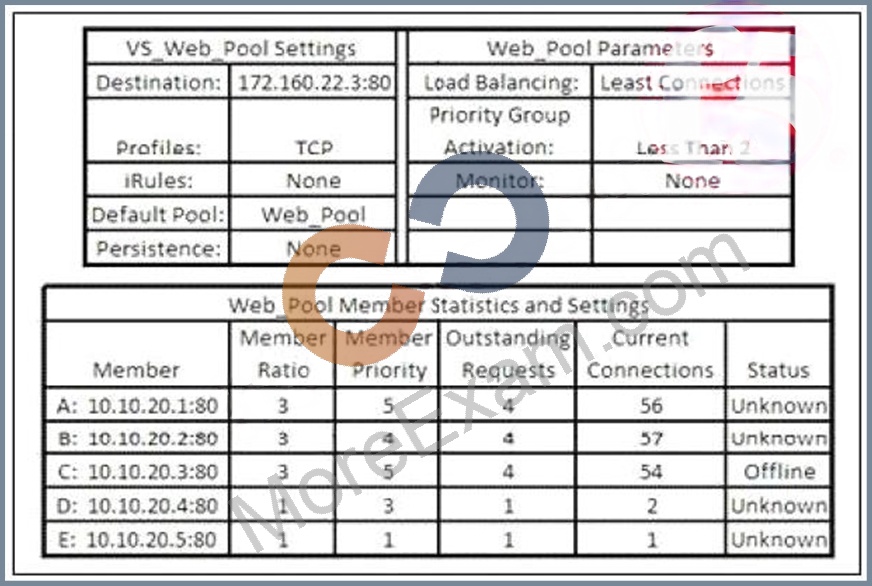
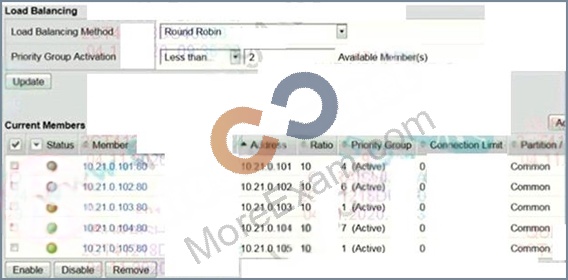
Question56: A BIG-IP device sends out the following SNMP trap:
big-ipo.f5.com - bigipExternalLinkChange Link: 1.0 is DOWN
Where in the BIG-IP Configuration utility should the BIG-IP Administrator verify the current status of Link
1.0?

Question57: The BIG-IP Administrator creates a custom iRule that fails to work as expected. Which F5 online resource should the administrator use to help resolve this issue?

Question58: During a maintenance window, an EUD test was executed and the output displayed on the screen. The BIG-IP Administrator did NOT save the screen output. The BIG-IP device is currently handling business critical traffic. The BIG-IP Administrator needs to minimize impact. What should the BIG-IP Administrator do to provide the EUD results to F5 Support?

Question59: A virtual server is listening at 10.10.1.100:any and has the following iRule associated with it: when CLIENT_ACCEPTED { if {[TCP::local_port] equals 80 } { pool pool1 } elseif {[TCP::local_port] equals 443} { pool pool2 } If a user connects to 10.10.1.100 and port 22, which pool will receive the request?

Question60: Which Virtual Server type should be used to load balance HTTP traffic to a pool of servers?

Question61: A development team needs to apply a software fix and troubleshoot one of its servers. The BIG-IP Administrator needs to immediately remove all connections from the BIG-IP system to the back end server. The BIG-IP Administrator checks the Virtual Server configuration and finds that a persistence profile is assigned to it. What should the 8IG-IP Administrator do to meet this requirement?

Question62: The current status of a given pool is offline (red). Which condition could explain that state? Assume the descriptions below include all monitors assigned for each scenario.

Question63: You have a pool of servers that need to be tested. All of the servers but one should be tested every 10 seconds, but one is slower and should only be tested every 20 seconds. How do you proceed.

Question64: Which two methods can be used to determine which BIG-IP is currently active? (Choose two.)

Question65: Assume the bigd daemon fails on the active system. Which three are possible results? (Choose three.)

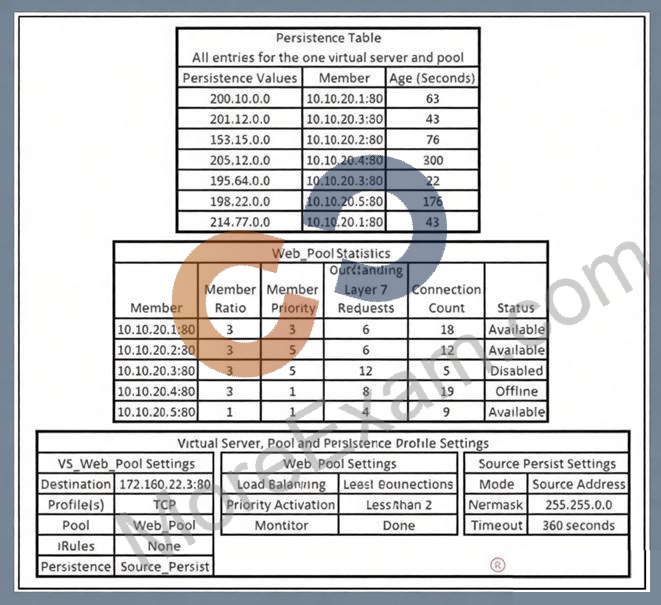
Question66: The incoming client IP address is 205.12.45.52. The last five connections have been sent to members C, D, A, B, B. Given the virtual server and pool definitions and the statistics shown in the graphic, which member will be used for the next connection?

Question67: Assume a client's traffic is being processed only by a NAT; no SNAT or virtual server processing takes place. Also assume that the NAT definition specifies a NAT address and an origin address while all other settings are left at their defaults. If a client were to initiate traffic to the NAT address, what changes, if any, would take place when the BIGElIP processes such packets.

Question68: When upgrading a BIGElIP redundant pair, what happens when one system has been updated but the other has not.

Question69: Assume a client's traffic is being processed only by a NAT; no SNAT or virtual server processing takes place. Also assume that the NAT definition specifies a NAT address and an origin address while all other settings are left at their defaults. If the origin server were to initiate traffic via the BIG-IP, What changes, if any, would take place when the BIG-IP processes such packets?

Question70: A virtual server is listening at 10.10.1.100:80 and has the following
iRule associated with it: when HTTP_REQUEST { if {[HTTP::uri] ends_with "txt" } { pool pool1 } elseif {[HTTP::uri] ends_with "php" } { pool pool2 } If a user connects to http://10.10.1.100/foo.html, which pool will receive the request.

Question71: Refer to the exhibit.

Which two pool members are eligible to receive new connections? (Choose two)

Question72: Which two statements describe differences between the active and standby systems? (Choose two.)

Question73: Which statement is true about the synchronization process, as performed by the Configuration Utility or by typing b config sync all?

Question74: The ICMP monitor has been assigned to all nodes. In addition, all pools have been assigned custom monitors. If a pool eb.is marked vailable.
The ICMP monitor has been assigned to all nodes. In addition, all pools have been assigned custom monitors. If a pool .eb.is marked .vailable (green) which situation is sufficient to cause this.

Question75: Which statement is true concerning cookie persistence?
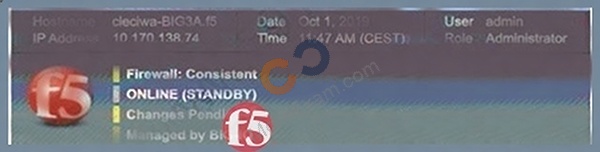
Question76: Interface 1.2 on a BIG-IP VE has a status of UNINITIALIZED. What is the reason for this status?

Question77: Refer to the exhibit.

The BIG-IP Administrator has modified an iRule on one device of an HA pair. The BIG-IP Administrator notices there is NO traffic on the BIG-IP device in which they are logged into.
What should the BIG-IP Administrator do to verify if the iRule works correctly?

Question78: How should a BIG-IP Administrator persistent sessions from being sent to a pool member so that the server administrator can perform maintenance?

Question79: One of the two members of a device group has been decommissioned. The BIG-IP Administrator tries to delete the device group, but is unsuccessful.
Prior to removing the device group, which action should be performed?

Question80: A virtual server is listening at 10.10.1.100:any and has the following iRule associated with it: when CLIENT_ACCEPTED { if {[TCP::local_port] equals 80 } { pool pool1 } elseif {[TCP::local_port] equals 443 } { pool pool2 } If a user connects to 10.10.1.100 and port 22, which pool will receive the request.

Question81: Generally speaking, should the monitor templates be used as production monitors or should they be customized prior to use.

Question82: Which must be sent to the license server to generate a new license.
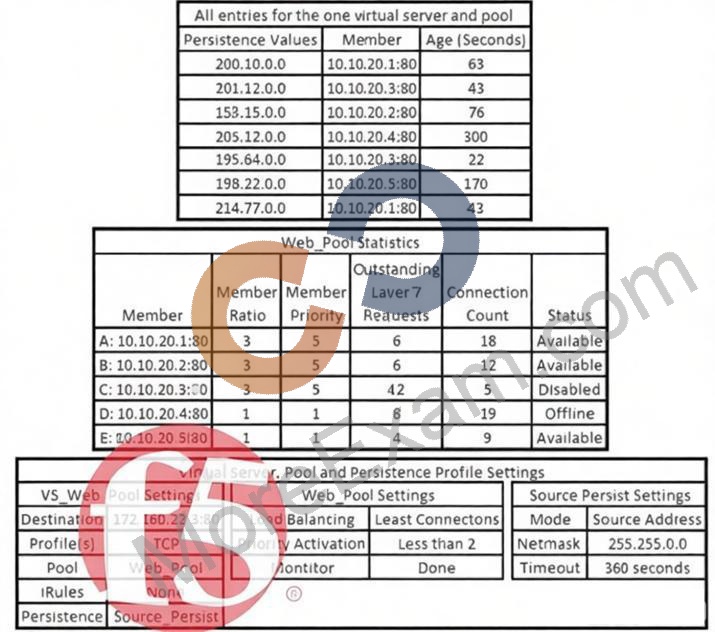
Question83: A virtual server is defined using a source address based persistence profile. The last five connections were A, B, C, A, C . Given the conditions shown in the graphic, if a client with IP address 205.12.45.52 opens a connection to the virtual server, which member will be used for the connection?

Question84: A BIG-IP Administrator wants to add a new Self IP to the BIG-IP device. Which item should be assigned to the new Self IP being configured?

Question85: Which statement is true regarding failElover.

Question86: A BIG-IP Administrator creates a new VLAN on BIG-IP Cluster Member A and attaches an Interface to it. Although the Auto Config Sync is in place, the new VLAN does NOT show up on Cluster Member B.
What should the BIG-IP Administrator do to ensure the new VLAN is configured on each Cluster Member?

Question87: A site needs to terminate client HTTPS traffic at the BEl II GP and forward that traffic unencrypted. Which two are profile types that must be associated with such a virtual server. (Choose two.)

Question88: Which method is recommended for creating a new user from the CLI?
Question89: Refer to the exhibit.

During a planned upgrade lo a BIG-IP HA pair running Active/Standby, an outage to application traffic is reported shortly after the Active unit is forced to Standby Reverting the flower resolves the outage. What should the BIG-IP Administrator modify to avoid an outage during the next for over event?

Question90: Which two can be a part of a pool's definition? (Choose two.)

Question91: A BIG-IP Administrator wants to add the ASM Module to an HA pair of BIG-IP devices. The BIG-IP Administrator has already installed a new Add-On License on both devices in the HA pair. What should the BIG-IP Administrator do next to use the module?

Question92: Which statement is true regarding failover?

Question93: All pool members are online. All other virtual server settings are at default What might after the load balancing behavior?

Question94: Which log file should the BIG-IP Administrator check to determine if a specific user tried to log in to the
8IG-IP Configuration by utility?

Question95: A set of servers is used for an FTP application as well as an HTTP website via separate BIG-IP Pools. The server support team reports that some servers are receiving a lot more traffic than others.
Which Load Balancing Method should the BIG-IP Administrator apply to even out the connection count?

Question96: Which two statements are true concerning the default communication between a redundant pair of BIG-IP systems? (Choose two.)

Question97: Which type of Virtual Server requires the use of a FastL4 profile?

Question98: A BIG-IP Administrator needs to configure the BIG-IP system to perform load balancing for FTP servers running passive mode FTP.
How should the administrator configure the Virtual Server to perform this load balancing?

Question99: A site needs a virtual server that will use an iRule to parse HTTPS traffic based on HTTP header values. Which two profile types must be associated with such a virtual server? (Choose two.)

Question100: A BIGJP Administrator needs to load a UCS file but must exclude the license file. How should the administrator perform this task?

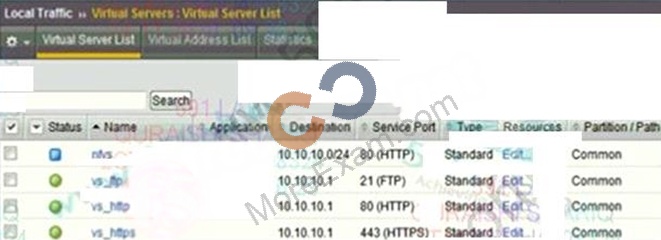
Question101: Refer to the exhibit

A connection is being established to IP 1.1.1.1 on port 8080.
Which virtual server will handle the connection?

Question102: DNS queries from two internal DNS servers are being load balanced to external DNS Servers via a Virtual Server on a BIG-P device. The DNS queries originate from 192.168.101.100 and 192.168.101.200 and target 192.168.21.50 All DNS queries destined for the external DNS Servers fail Which property change should the BIG-IP Administrator make in the Virtual Server to resolve this issue?

Question103: The BIG-IP Administrator needs to perform a BIG-IP device upgrade to the latest version of TMOS. Where can the administrator obtain F5 documentation on upgrade requirements?

Question104: Where is the loadbalancing mode specified?

Question105: What is the purpose of provisioning?

Question106: The 8IG-IP Administrator generates a qkview using "qkview -SO" and needs to transfer the output file via SCP.
Which directory contains the output file?

Question107: Where is persistence mirroring configured?

Question108: You have created a custom profile named TEST2. The parent profile of TEST2 is named TEST1. If additional changes are made to TEST1, what is the effect on TEST2?

Question109: If a client's browser does not accept cookies, what occurs when the client connects to a virtual server using cookie persistence?

Question110: Which two methods can be used to determine which BIGElIP is currently active.
(Choose two.)

Question111: A virtual server is listening at 10.10.1.100:any and has the following iRule associated with it: when CLIENT_ACCEPTED { if {[TCP::local_port] equals 21 } { pool ftppool } elseif {[TCP::local_port] equals 23 } { pool telnetpool } If a user connects to 10.10.1.100 and port 22, which pool will receive the request.

Question112: A BIG-IP Administrator configures a Virtual Server. Users report that they always receive a TCP RST packet to the BIG-IP system when attempting to connect to it. What is the possible reason for this issue?

Question113: Assume a client's traffic is being processed only by a NAT; no SNAT or virtual
server processing takes place. Also assume that the NAT definition specifies a
NAT address and an origin address while all other settings are left at their defaults.
If the origin server were to initiate traffic via the BIGElIP, what changes, if any,
would take place when the BIGElIP processes such packets.

Question114: A BIG-IP device is configured with both an internal external and two Corporate VLANs. The virtual server has SNAT enabled and is set to listen on all VLANs Auto Last Hop is disabled. The Corporate users are on
10.0.0.0./24 and 172.16.0.0/12. The BIG-IP has a Self-IP on the 1.0.0.0.0./24 subnet.
Internet users are able to access the virtual server. Only some of the Corporate users are able to connect to the virtual server A BIG-IP Administrator performs a tcpdump on the BIG-IP and verifies that traffic is arriving from users in 10.0.0.0/24.
What should the BIG-IP Administrator do to correct this behaviour?

Question115: Which is an advantage of terminating SSL communication at the BIGElIP rather than the ultimate web server.

Question116: A virtual server is defined per the charts. The last five client connections were to members C, D, A, B, B . Given the conditions shown in the above graphic, if a client with IP address 205.12.45.52 opens a connection to the virtual server, which member will be used for the connection.

Question117: A site needs a virtual server that will use an iRule to parse HTTPS traffic based on HTTP header values. Which two profile types must be associated with such a virtual server. (Choose two.)

Question118: Some users who connect to a busy Virtual Server have connections reset by the BIG-IP system. Pool member resources are NOT a factor in this behavior. What is a possible cause for this behavior?

Question119: Which statement describes a typical purpose of iRules.

Question120: A site has six members in a pool. All of the servers have been designed, built, and configured with the same applications. It is known that each client's interactions vary significantly and can affect the performance of the servers. If traffic should be sent to all members on a regular basis, which loadbalancing mode is most effective if the goal is to maintain a
relatively even load across all servers.

Question121: When can a single virtual server be associated with multiple profiles?
Question122: Refer to the exhibit.

According to the shown Configuration Utility stings What is the setting of the User Directory configuration under the Authentication submenu?

Question123: The BIG-IP Administrator configures an HTTP monitor with a specific receive string. The status is marked
'down'.
Which tool should the administrator use to identify the problem?

Question124: Which two can be a part of a virtual server's definition. (Choose two.)

Question125: You have a pool of servers that need to be tested. All of the servers but one should be tested every 10 seconds, but one is slower and should only be tested every 20 seconds. How do you proceed?

Question126: New Syslog servers have been deployed in an organization. The BIG-IP Administrator must reconfigure the BIG-IP system to send log messages to these servers.
In which location in the Configuration Utility can the BIG-IP Administrator make the needed configuration changes to accomplish this?

Question127: Which VLANs must be enabled for a SNAT to perform as desired (translating only desired packets).

Question128: Which cookie persistence method requires the fewest configuration changes on the web servers to be implemented correctly.

Question129: The current status of a given pool member is nknown. Which condition could explain that state. The current status of a given pool member is .nknown. Which condition could explain that state.